
On entering Mrs Stalder's flat, among the wide variety of artworks adorning the living room, dining room, kitchen and hallway, the first things to catch the eye are the mobiles shining brightly in the sun. That gets us straight into conversation and she explains: «The mobiles are made of acrylic glass; working with it is very strenuous. There are blocks of two by three metres that you have to select, cut to shape and finally sand down. My largest object in acrylic glass is in the Allerheiligen church in Basel. It is five metres high and consists of twelve threads. A mobile that catches the thermals and can turn.» She tells us that in the church it is a symbol for Easter and adds: «I think it is a fitting symbol for Easter and for life. It moves of its own accord and turns, reflects, gleams, like life itself.»
Asked about her professional path into the field of art she says: «My first vocational training was as a primary school teacher. The drawing teacher at the teacher training college said I should go to the Zurich School of Applied Arts after graduating. While I was already employed as a teacher, I went from there to the School of Applied Arts two or three times a week and did the training alongside.» She goes on to tell us about the moment when she decided really to practise art as a profession and to pursue it seriously. «At 27 I married and then there was an exhibition for young artists in Sissach for the first time. I took part. We were all standing outside before the opening and waiting, nobody knew that I painted. And then in the end my pictures were in the most beautiful room. After that the cantonal bank bought two pictures of mine and that made a great impression on me. Then I thought: if that is how it is, then I have to take it seriously and have to work more. And then I began to work properly, not just on the side. That was the start, after which I regarded it as a profession throughout my life.»
Finally we come to talk about the Christmas card, about whose background Mrs Stalder says: «I was invited by the gallery owner who put on this exhibition. He went to Provence and rented a small house for seven weeks. It took me a long time to say yes, but in the end I decided to do it. The gallery owner took me on an excursion every day to show me Provence. He took me up the Montagne de Lure, and from there I drew towards the southern Alps.» About the works in the exhibition she says: «I did of course draw a little there. This exhibition consists only of works that came about within barely a year from the drawings from Provence. I have never done that before, an exhibition from such a short period. I worked in the morning, in the afternoon and after dinner. There were 21 oil paintings in this exhibition. That is a lot for me, because I work on them for a long time. And 17 works on paper were exhibited; I made even more. All about Provence.»
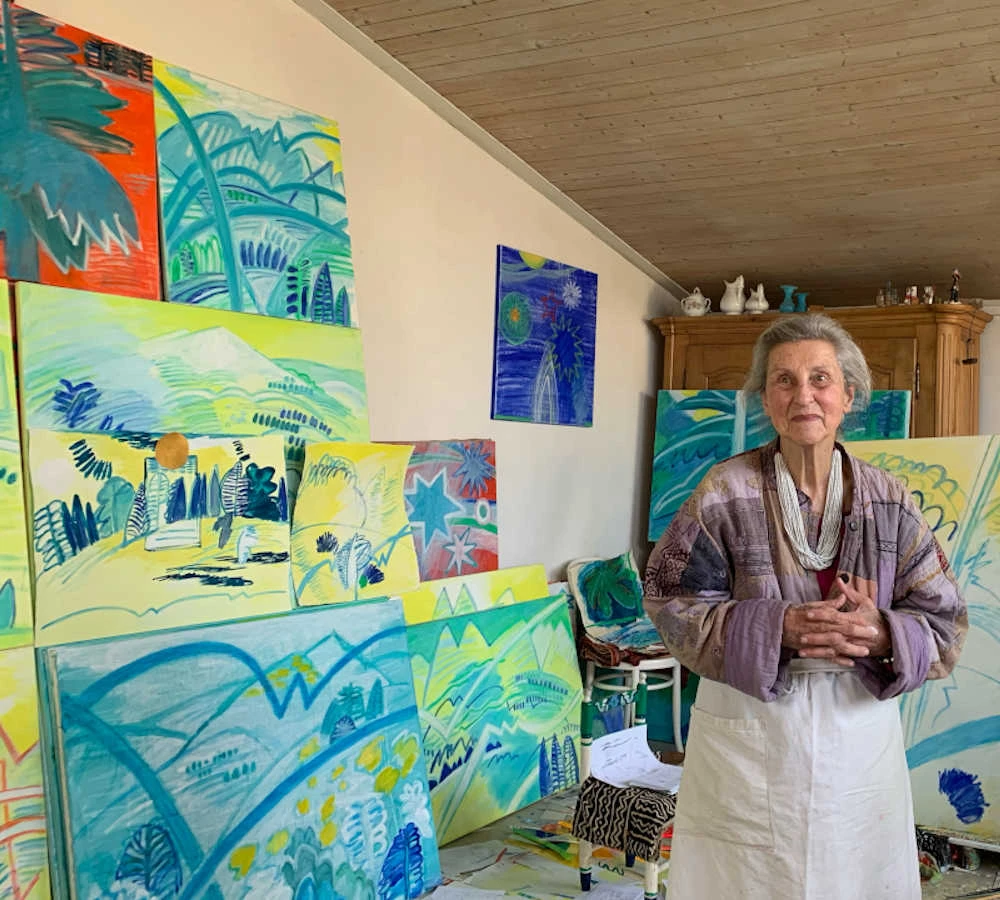
At this point we move upstairs to her studio, which is directly above the flat, so that she can show me her works. It is a spacious attic room in which colourful pictures, a wide variety of materials and pencil sketches lie together in a bright mixture. Asked what kind of paint the works in front of me are made with, Mrs Stalder explains: «That is oil paint, and indeed the old oil paint, not acrylic. Acrylic is dry in a quarter of an hour and then no change is possible any more, I would have to paint over it. But oil paint can be washed off again with turpentine and pictures can still be altered.» About the process of creating her works she says: «First I make sketches, then many drawings lie in between before the final picture» - and she shows me the mountain of drawing sketches. «What is more, I carry on working every day. It is not a new beginning the next day. And sometimes I am very curious how I will find it when I have done something more in the evening and look at it the next morning with fresh eyes.»
Regarding the content of her pictures she says: «Around the new year 2020 into 2021 I thought: the time in Provence is already so far away, was it not just a dream?» She shows me a picture in which a slope with flowers can be seen: «That is the slope with these houses from Provence and those are the dream flowers.» Asked where her artworks can be placed stylistically, she answers: «With the Provence pictures, for example, there is a real background, Provence, but it is already shaped by me, shaped away from nature into a picture.» She thus uses many imaginative elements and brings them together with real features that are depicted abstractly. Emotions also play an important role. She emphasises that, besides dream flowers, «paths» are a recurring symbol for her. «That can also mean paths through life. Paths into this landscape. Finding your way in life.»
We would like to thank Elisabeth Stalder warmly for this interesting insight and wish everyone happy holidays and a good start to the new year!