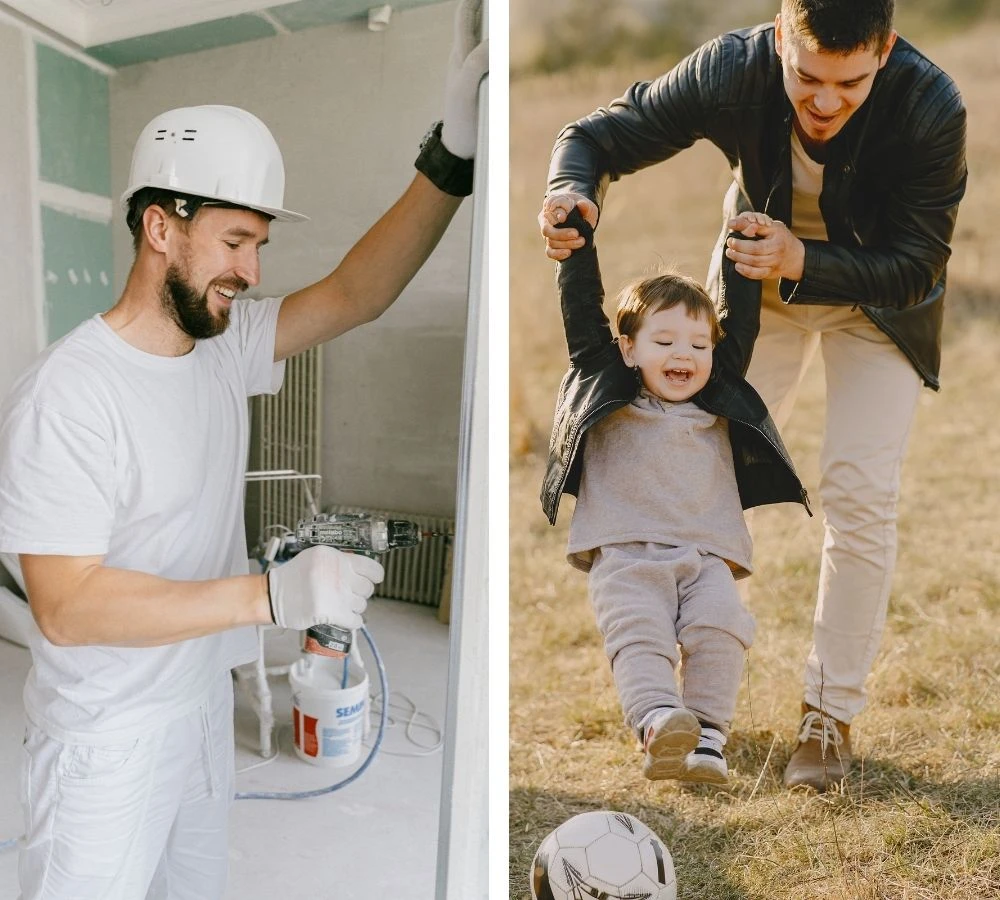

Physically demanding work in all weather conditions - and for more than eight hours a day - probably attracts very few into the construction industry given the various career alternatives available today. Social trends are heading towards work-life balance, flexible working hours and perhaps a sharing of paid work between both partners while raising children. Young people in particular want to spend more time with their family, meet friends more often or be able to pursue their personal hobbies and interests. The increasing demand for part-time working models, especially among the younger generation, is therefore an important topic with regard to more attractive employment conditions. After all, demand for part-time positions - particularly in the construction trade - is considerably greater than what companies actually offer.
While in the service sectors, in which a considerably higher percentage of women work, it is by no means unusual to advertise positions with a stated percentage of full-time hours, this is hardly the case in the construction trade, in which many men work. Although the proportion of part-time workers in Switzerland has risen over the last 25 years among both men and women, part-time work is still distributed rather unequally between the sexes: today the majority of working women, almost 60 per cent, work part-time hours, whereas among men it is not even 20 per cent.
It is therefore hardly surprising that the proportion of part-time employees in the service sector is a proud 46 per cent (2017), whereas in industry and construction it amounts to only 16 per cent (2017). The proportion of part-time positions specifically in the construction industry did rise from 9.3 per cent in 1991 to 14.3 per cent by 2017, but is extremely low compared with other sectors. On top of this comes the large difference between the sexes: the proportion of women in part-time hours was 62.8 per cent in 2017, but among men only 7.7 per cent. The proportion of men working part-time in the construction industry is thus almost three times lower than the already low average proportion of men in part-time hours.
If you compare these figures with the ideas about roles and family examined in the Federal Council's family report (2017), it becomes obvious at which point employment in the construction industry loses attractiveness in every case. Asked about their ideal picture regarding the division of paid work, women and men between 25 and 54 with pre-school children most frequently name the model «both parents working part-time» (36% of men, 42% of women), closely followed by «father working full-time, mother part-time» (34% of men, 32% of women). This shows the clear demand for part-time working opportunities, both from men and from women, above all in a family context. In reality, however, realising this ideal is evidently only difficult or rare: with only 9 per cent of respondents, for example, do both parents live and work part-time hours.
Through the interviews we conducted personally with people working in the roofing, landscaping, road construction and bricklaying trades, we gained the impression, with regard to part-time working opportunities, that for those for whom working part-time is a great concern, this option is also achievable. However, part-time work is still not a widespread model; the 100 per cent workload is the usual standard. We also heard that part-time work as a member of the workforce is less problematic, whereas as a foreman it is certainly more difficult because of the greater responsibility and leadership role.
The reason for the still poorly established part-time options in the construction industry is probably, on the one hand, the - today barely current - image of the full-time working father who provides for his family through his work alone. On the other hand, many construction firms encounter problems in practical terms in dealing with individual working hours for their employees. Greater coordination effort, more laborious planning and insufficient communication are probably the biggest obstacles here. This is where the right tools come in: with Vanillaplan's special part-time function it is easily possible to set an individual part-time workload for each employee, so that this is automatically taken into account and scheduled in deployment and capacity planning. Targeted planning can therefore take place without extra effort - and part-time work can be made possible.
In view of the problem of the growing shortage of young talent and skilled workers in the construction industry mentioned at the beginning of the article, it can be said in conclusion that part-time working models are probably an important and unavoidable prerequisite for reconciling work and family and thus ultimately also for equality between men and women in working life. The fact that family life is changing in such a way that fathers too want to be consciously involved in their children growing up, while women may not want to withdraw entirely from working life, makes part-time working models necessary on both sides. In order to appeal successfully to the young generation of men and women and win them over to work in the construction industry, modern employment conditions such as part-time working opportunities are an important step.