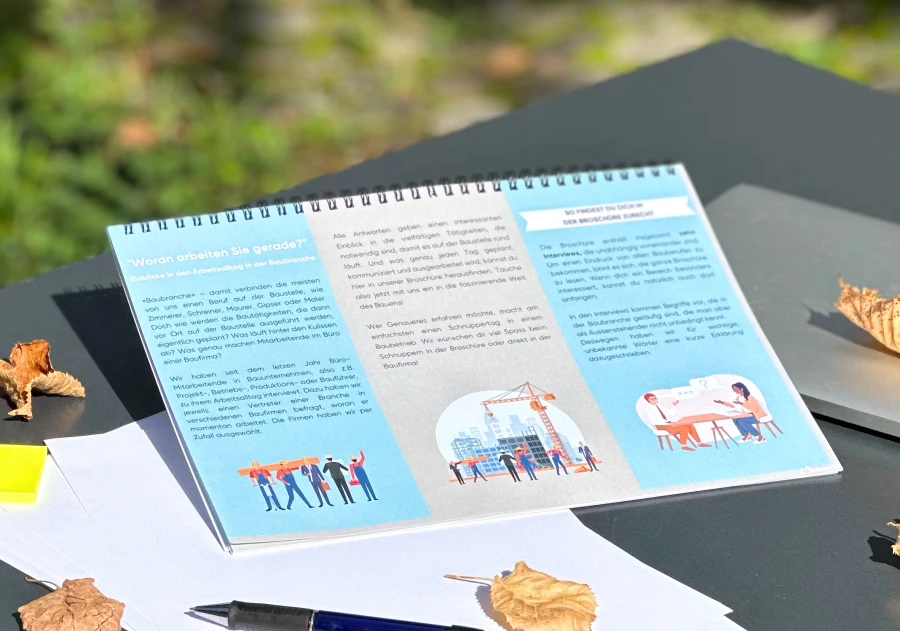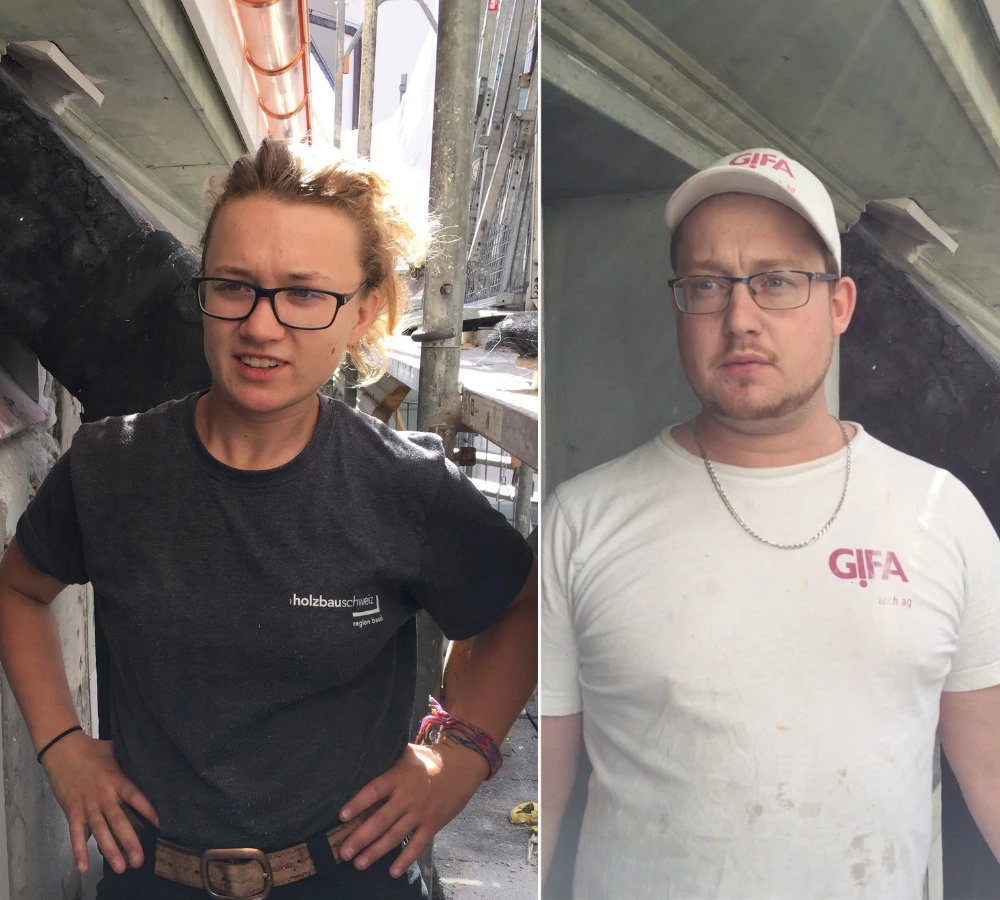

We at Vanillaplan think it is great that there is one day in the year on which the skilled trades take centre stage! We would welcome such a day in Switzerland too, and are therefore taking it as an occasion to look more closely at different skilled trades here as well. To that end we would like to interview different occupational groups every year on the Day of Crafts and put together how they see their trade, what they appreciate about it and what career opportunities there are. This year we chose the trades of carpenter, plasterer and electrician and got a lot of fascinating information in the interviews. Here we go!
Carpenter, plasterer, electrician - a childhood dream?
Unfortunately not really. None of the three tradespeople interviewed was sure from an early age that they wanted to practise their current trade later on. However, the broad direction - taking up a manual trade and work outdoors involving physical activity - was already quite clear to all of them early on. Once they had been able to get to know the trade properly through a taster apprenticeship or through acquaintances who worked in the trades, all three were convinced they wanted to practise it later. After leaving school they all began their apprenticeships, which were perceived as predominantly positive, if sometimes demanding. Above all the few holidays compared with school and the more physical work were felt to be difficult at first.
A typical day as a carpenter, plasterer and electrician - and what is cool about it
What all three like best about their trade is that the work is varied and multi-faceted and always takes place in different locations.
The carpenter highlights positively that she can always improve something in her work. She is currently working on an 800-year-old roof structure and thinks it is great to see how things were built in the past and how that can be done better with today's means. She also finds the work on the roof very enjoyable - not least because of the view.
What the plasterer particularly likes about his trade is that he can also carry out creative work such as wall coatings or filling techniques.
What the electrician likes best about his work is that he can be out and about a lot and is not tied to one place. He finds it particularly exciting that innovations keep coming along, that every day is different and that he has many opportunities for further training in his field.
The negative aspects of the skilled trades
Here too all three name similar things: they all find the physical work strenuous and often less pleasant.
For the carpenter, who works largely outside enclosed spaces on the roof, the summer heat or winter cold is the biggest problem. You do get used to these conditions quite quickly, however.
The plasterer names base plastering in particular as the less positive activity in his trade, because of the physical exertion and the lack of creative scope.
For the electrician, chasing and chiselling are among the more negative tasks, likewise because of the physical exertion.
Skilled trades and family - is part-time work possible too?
Here they all report that, because of the difficulty of planning on the firm's side, part-time work is rather rarely possible. Ideally a job should be handled from start to finish, which makes a workload of under 80 per cent difficult. However, those interviewed emphasise how well work and family can be reconciled, since there is no work on Saturdays and Sundays and the whole weekend is therefore free.
On the construction site for ever? - Future prospects and further training in the trades
Although the question about future opportunities in the skilled trades was actually almost the last question on our list, we had the feeling that the conversation only really got going from here! We were positively showered with explanations of opportunities for further training and additional qualifications.
In the carpenter's trade, accordingly, you can on the one hand do further training that means you still work on site, but in a leadership position. That would be foreman or site foreman.
In the carpenter's trade, accordingly, you can on the one hand do further training that means you still work on site, but in a leadership position. That would be foreman or site foreman.
On the other hand you can qualify as a master craftsman, which entitles you to become self-employed and through which you can increasingly take on tasks that have less to do with the work outside on site.
Beyond that there is the option of studying at a university of applied sciences and training either for the profession of technician, who takes on planning and drawings, or of civil engineer specialising in timber construction.
By and large the electrician is very satisfied with the further training opportunities in his field and describes them as extremely varied compared with some other skilled trades. He tells us about the possibility of becoming a project manager, which is similar to site foreman and foreman. You can also train as a telematics technician, which is a qualification at the same level but reaches into a different field of work that has more to do with the internet.
He too mentions the option of qualifying as a master craftsman and thus being able to found your own company. The master craftsman qualification is quite demanding, however, so that it is not worth doing in every case.
He considers the vocational baccalaureate a sensible option in principle, but says most people who work in a skilled trade struggle greatly with either languages or arithmetic. He himself, for example, has a big problem with languages. Since the vocational baccalaureate brings both together again, that represents a major challenge for many, and some simply have no desire to deal with French, for example, all over again. It therefore certainly involves effort and is only worthwhile if you really want to go on to study afterwards and do something completely different.
Beyond that, preparing for the vocational baccalaureate is in some cases also a financial and a time problem. Some firms pay less because you are at school for half a day or a whole day instead of in the business. With a wage that is already rather low, that really is a problem. Conversely, there are also businesses that strongly encourage the vocational baccalaureate and offer, for example, a sum of 1,000 francs as an incentive to pass. So it depends very much on the business.
In general he thinks it a good idea to do training and further training while working, that is, alongside the job. It is considerably more practice-oriented, you already bring work experience with you and know how things go on the construction site.
The carpenter agrees with this. She does not at all regret not having gone to grammar school, because there are such good options now. The worry of doing an apprenticeship, then wanting to study after all and being stuck in the trade for ever is relatively unfounded these days. You can easily do the vocational baccalaureate or the bridging course and in the end study something that has nothing at all to do with the construction trade. And in a relatively short time, since the apprenticeship takes as long as grammar school, but with the advantage that a grammar school qualification does not get you much, whereas the apprenticeship entitles you to a great deal. That is why she thinks choosing to begin an apprenticeship is a very good decision.
We would like to thank the three of them warmly for taking the time for our interview during their lunch break!